Valtra Smart Display
Primary driving HMI for heavy machinery
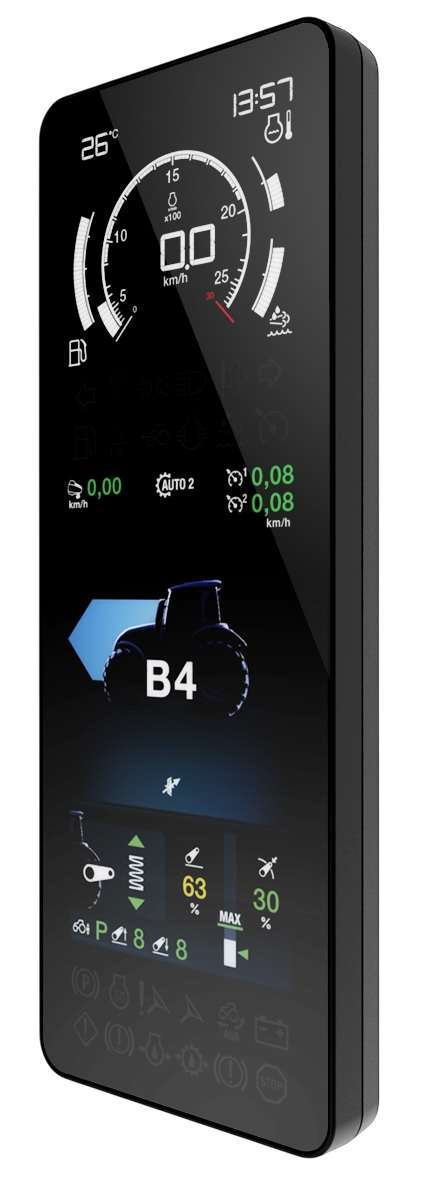
Smart Display replaces the traditional instrument cluster and brings driving-critical information into a more visible position on the right-hand A-pillar. It is designed for continuous, glance-based use while operating the machine — distinct from the armrest-mounted SmartTouch terminal, which supports deeper interaction and configuration.
The Challenge
Tractors are used for long working shifts in demanding conditions, often requiring operators to make decisions while moving and under load. Traditional instrument clusters are frequently obstructed by the steering wheel and are not optimized for modern feature sets or new operator expectations. The goal was to create a driving display that stays legible, predictable, and low-effort to interpret — even in harsh outdoor environments.
- Glance-based use while driving: Critical information must be understood immediately with minimal cognitive distraction.
- Harsh conditions: Direct sunlight, vibration, dust, and operation with gloves.
- Safety and predictability: Status, warnings, and key driving information must be unambiguous.
My Responsibilities
- Interaction design and UX architecture for the driving context
- Visual UI design and component system
- Information hierarchy, glanceability, and readability
- Prototyping, iteration, and design validation collaboration
Team Context
- Product management
- Embedded software development
- Hardware and mechanical design
- Usability and validation specialists
Constraints & Reality
The work was shaped by real-world constraints typical to embedded, safety-critical systems. These constraints directly informed visual hierarchy, interaction choices, and what could be shown at a glance.
- Embedded platform: Fixed resolution/aspect ratio with limited compute and memory → prioritize clarity, hierarchy, and efficient UI patterns.
- Scalability: Needed to work across multiple tractor models and configurations → modular UI and reusable components.
- Global requirements: Internationalization and safety-related standards → consistent states, predictable behavior, and careful information prioritization.
Engineering Collaboration
Designing for an embedded, safety-critical platform required close collaboration with software engineering. Beyond creating the interface itself, I ensured that graphical assets were optimized for the target hardware while preserving usability and visual quality.
Working within embedded constraints meant balancing image quality, memory usage, rendering performance, and maintainability throughout the asset pipeline.
One example was eliminating visible color banding in interface gradients. Together with the software engineer, we developed an automated dithering workflow that significantly improved visual quality while remaining compatible with the embedded rendering pipeline.
User Validation
Validation included iterative prototype evaluations with operators using a full-scale tractor mock-up, allowing the interface to be refined under realistic working conditions before production. Feedback from these sessions directly influenced interaction flows, information hierarchy, and overall visual clarity.
Customer feedback sessions with real farmers and operators helped validate information hierarchy, glanceability, navigation patterns, and visual clarity under simulated operational conditions. The empirical findings directly influenced multiple layout iterations throughout development, ensuring the final cluster optimized cognitive load during high-task driving scenarios.
Key Design Decisions
1. Moved the instrument cluster to the right-hand A-pillar
Reason: Traditional clusters behind the steering wheel are often partially obstructed and require larger eye movement. The A-pillar position improves visibility and reduces head/eye movement during operation.
Outcome: Driving-critical information stays more consistently within the operator’s field of view, supporting safer and more comfortable long-term use.
2. Optimized hierarchy and contrast for high readability
Reason: The display must remain legible in bright outdoor conditions and support long shifts without increasing visual fatigue.
Outcome: Key information is easier to scan at a glance, with reduced visual noise and clearer prioritization of critical states.
3. Designed Smart Display as a complementary sibling within Valtra’s HMI ecosystem
Reason: Smart Display and SmartTouch have different roles — one supports continuous driving awareness, the other deeper interaction — but operators benefit from a shared visual language and predictable patterns across the ecosystem.
Outcome: The Smart Display feels familiar to existing Valtra users while remaining purpose-built for its role as the primary driving interface.
4. Kept primary flows intentionally simple with contextual depth
Reason: Driving-focused tasks require immediate access to essentials. Advanced functions should remain available, but not compete for attention in the main view.
Outcome: Core driving information stays distraction-free while complex functionality remains accessible through clear, contextual paths.
Visual System
The visual system was designed to support fast recognition in motion and harsh conditions: clear typography for distance viewing, high-contrast states for status and warnings, and iconography designed to remain recognizable under vibration and glare.
Project Outcome
The Smart Display was successfully delivered as part of Valtra's next-generation HMI platform, replacing the traditional instrument cluster with a modern, glance-based driving interface.
Throughout development, the interface evolved through continuous design iteration, close engineering collaboration, and user validation, resulting in a solution that balances visual clarity, performance, and safety within the constraints of an embedded platform.
The project contributed to the award-winning Valtra S Series, recognized with:
- Red Dot: Best of the Best
- iF Design Award
- Good Design Award
This case study presents only publicly available information. Additional project work remains confidential due to commercial agreements.
“In safety-critical environments, clarity, predictability, and restraint often matter more than visual expressiveness.”